
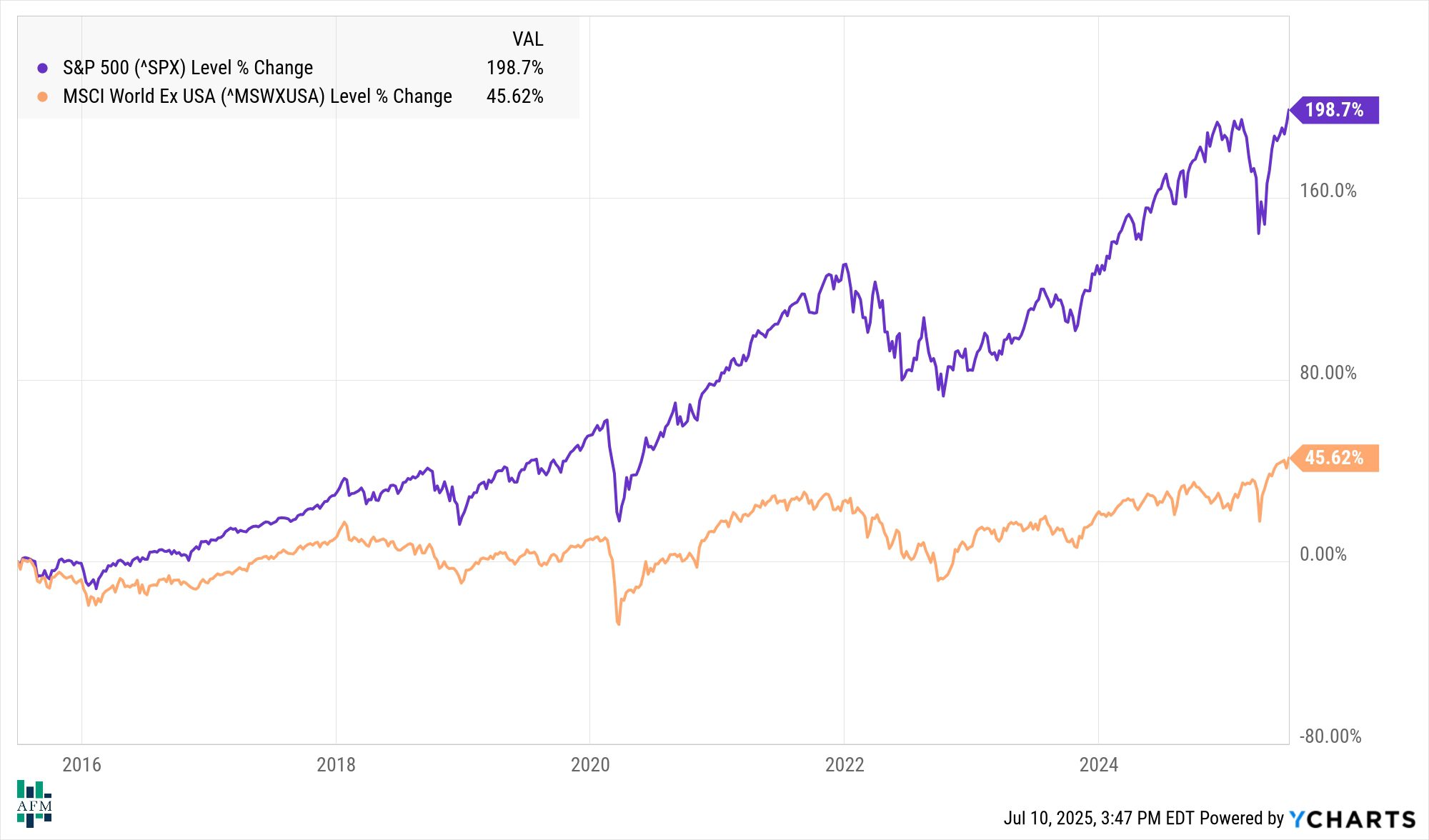
U.S. stocks have delivered remarkable returns over the past ten years as noted in the chart below, prompting some investors to question the value of holding international stocks. However, in an increasingly interconnected global economy, focusing exclusively on domestic equities can limit your opportunities and increase portfolio risk. Here’s why international stocks remain an essential component of a well-diversified investment strategy.
U.S. Stocks Don’t Always Outperform
Given the recent U.S. stock outperformance, you might assume that outperformance will continue, but that’s just recency bias at work. While U.S. equities have outperformed over the past decade, history shows that market leadership rotates. International stocks did far better at times in the 1970s, 1980s and 2000s, as shown in the chart below. Remember, past performance is not indicative of future results.

Diversification Can Help Protect Against Volatility
Diversifying across various countries and economies helps reduce exposure to risks specific to any single market. International stocks provide valuable diversification because global markets do not always move in tandem with the U.S. For example, when U.S. equities experience volatility, international markets may remain stable or even outperform, helping smooth out your portfolio’s returns. Staying diversified means that some parts of your portfolio may underperform at times, but remember – it’s impossible to predict which asset class or strategy will outperform or lag in any given period.
Access Growth Opportunities Beyond U.S. Borders
The U.S. is home to many leading multinational companies, some of which generate a significant portion of their revenue overseas. However, this is not a substitute for direct international exposure. Many of the world’s fastest-growing economies and most innovative companies are located outside the U.S. and may not have comparable U.S. counterparts. For instance, while Nvidia leads in developing graphics processing units for AI, companies like Taiwan Semiconductor (which manufactures these chips) and ASML Holding (which supplies the equipment) are based abroad. Focusing only on U.S. stocks could mean missing out on compelling opportunities overseas.
Attractive Valuations and Cyclical Opportunities
Following years of U.S. market outperformance, many international stocks now trade at significant discounts relative to their historical averages and to U.S. peers. Of course, non-U.S. stocks have long been inexpensive for a reason as earnings growth has been weak compared to the U.S. Could U.S. stocks stay expensive? Absolutely, if the strong U.S. earnings growth continues, however, this leaves little margin of safety if growth disappoints investors’ expectations. It is also important to recognize that valuations alone are not a guarantee of future outperformance.

Foreign Currency Exposure Turns into a Tailwind
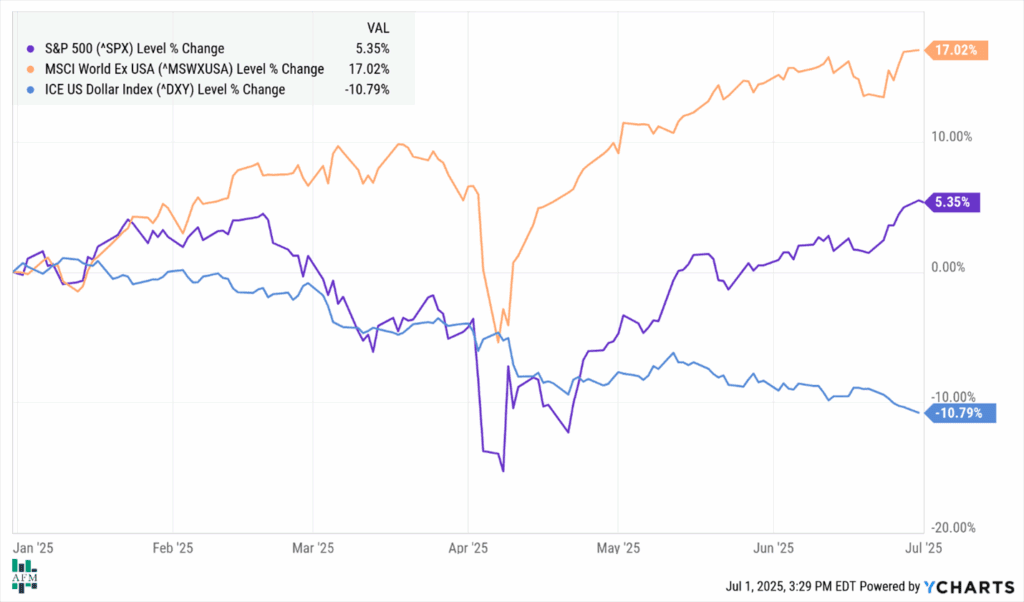
Investing in international stocks also means adding exposure to a variety of currencies. Currency effects can either help or hurt returns. A stronger U.S. dollar makes buying foreign goods or traveling abroad less expensive for Americans, but it can reduce returns on international stocks. Conversely, a weaker dollar can boost international stock returns for U.S. investors. Ongoing fiscal and trade policy uncertainties may put pressure on the dollar, and while it is likely to remain the world’s reserve currency, a gradual weakening could offer a tailwind for international investments. As you can see in the chart below, the decline in the ICE U.S. Dollar Index has provided a significant boost to international stock performance so far this year. It is the worst first-half performance for the U.S. Dollar Index since 1973 when Richard Nixon was president.
Think Globally, Invest Wisely
For the first time in years, several catalysts are improving the outlook for international stocks, including fiscal stimulus in Germany, corporate reforms in Japan and South Korea, a weakening U.S. dollar, stabilization in China, and improved policy dynamics across Europe. While it is impossible to predict if recent international stock performance marks the beginning of a sustained trend, these developments highlight the importance of global diversification. These developments underscore the value of looking beyond U.S. borders. The global opportunity set is far too vast to ignore.
The main risks of international investing are currency fluctuations, differences in accounting methods; foreign taxation; economic, political or financial instability; lack of timely or reliable information; or unfavorable political or legal developments. This material is intended for informational/educational purposes only and should not be construed as investment advice, a solicitation, or a recommendation to buy or sell any security or investment product. Please contact a financial professional for more information specific to your situation.
Presented by Carl Holubowich, CFP®
