
Shares of SpaceX debuted on the stock market earlier this year in what became the largest initial public offering (IPO) in history, with the company valued at $1.8 trillion the day shares began trading.
In an IPO, companies do not typically offer up 100% of the company for sale, and in fact SpaceX targeted a relatively small sale of $75 billion worth of shares. While it represented just 4% of the company, this still dwarfed the largest IPOs in US market history.
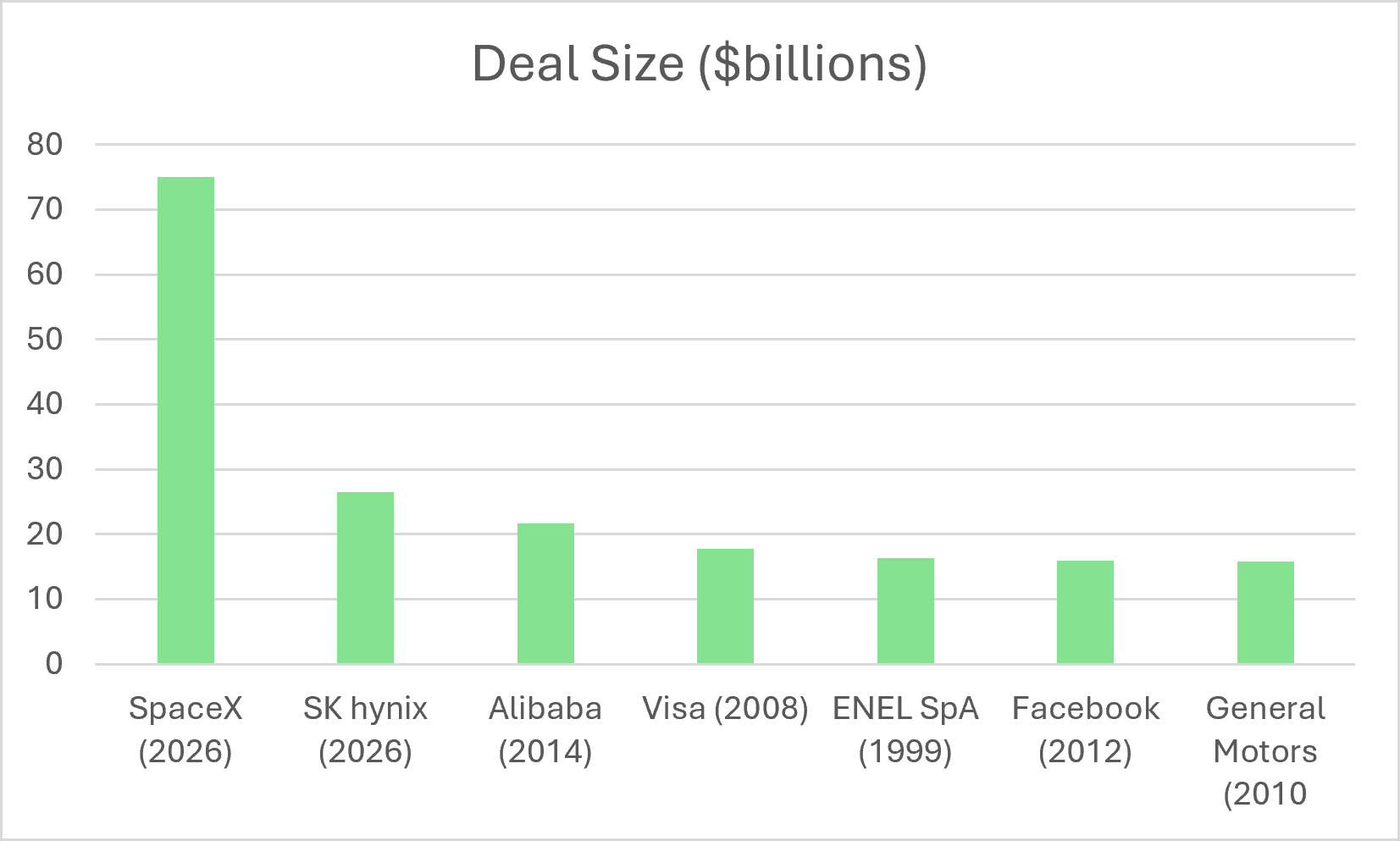
While this outsized IPO may seem like an anomaly, it appears to be the first in a coming wave of mega-sized IPOs over the next two years. Markets are already preparing for shares of Anthropic to hit the market this fall, with OpenAI and others expected to follow in 2027.
Why are the current wave of IPOs coming to market at a scale that dwarfs prior giants? What does it tell us about how financial markets have changed? How might this new class of mega caps affect the markets? And how much attention should investors give them?
Every Generation Has Had Its Defining IPOs
Every generation has a handful of companies that capture the public’s imagination and become shorthand for what was happening in the economy at the time. The most famous recent example is the fever pitch during the initial tech boom of the late 1990s and early 2000s. At the time, it was difficult to predict winners and losers, so Amazon.com, eToys, Pets.com, and Google (to name just a few) were all breathlessly hyped as the next big thing.
Many of these stocks saw their share prices leap higher once they hit the market, even as some were burning cash behind the scenes and were mere months from going out of business. For every Amazon or Google that paid off handsomely long-term, there were a dozen that flamed out.
It can be easy to see similarities between the dot-com boom and the current AI boom. SpaceX was valued at $1.8 trillion the day of its initial public offering. Anthropic is expected to go public at a valuation approaching $2 trillion, followed by OpenAI (also well above $1 trillion) in early 2027. Behind them is a wave of $100 billion companies like Stripe, Databricks, and ByteDance, along with a host of private companies in the $10 billion to $100 billion range. While there are IPOs coming in traditional brick-and-mortar industries, the AI giants are generating the most buzz.
The sheer size of these companies offers a clue to how markets and the economy have changed over the past 15 years.
A Different Starting Point
Prior to the global financial crisis of 2008, startup companies primarily funded growth through the public markets. The cliché was to start a company in your garage, get a few friends and family to buy in, and build something up enough that you could attract a bit of outside investment. If you got that far, the path to exponential growth was to issue shares to the public.
Hewlett Packard was founded in 1938 out of a garage in California, in what is now credited as the birth of Silicon Valley, and that same process still held true nearly 60 years later, when Jeff Bezos launched Amazon from his Bellevue, WA garage.
In the aftermath of the global financial crisis, things changed. In response to the severe market volatility of 2008-09, there was a significant increase in the amount of private, off-market investment in hedge funds, private equity and venture capital, private debt, and special purpose vehicles. Over the past 15 years this money has increasingly poured into start-ups and established companies that are not yet publicly traded.
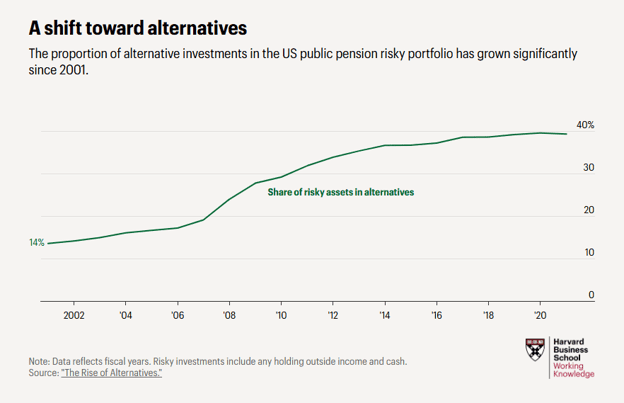
As a result, companies now have less incentive to go public in their infancy. With larger pools of private capital available, companies can grow to a scale previously unthinkable outside of public markets. In addition, accepting private money and growing privately offers more flexibility and less responsibility in terms of financial reporting and shareholder expectations. On a recent episode of The Compound and Friends, Josh Brown said, “the private markets are like kindergarten, where everyone’s nice to everyone. The public market is a gladiator pit.”
The Rise of Private Value Creation
As market dynamics changed, the mechanics of IPOs have changed. This has also led to a shift in who takes the risk and who gets rewarded.
When Microsoft (1986), Amazon (1997), and Google (2004) went public, investors gained access relatively early in each company’s corporate life. Today’s private markets allow many businesses to spend years creating value before public investors ever have the opportunity to purchase shares. SpaceX, after starting with a large seed investment from Elon Musk in 2002, went through dozens of private investment rounds over 24 years before going public.
Historically, investors viewed an IPO as an opportunity to help fund a company’s future growth. Increasingly, public investors are being invited to participate in companies that have already experienced years of growth, innovation, and value creation behind closed doors. The IPOs serve a secondary function as a means to reward early private investors by enabling them to cash out and sell some of their shares to the public, to gain liquidity and lock in their gains.
The companies coming public today are often already operating at a scale that previous generations would have associated with established public companies. This presents a tradeoff.
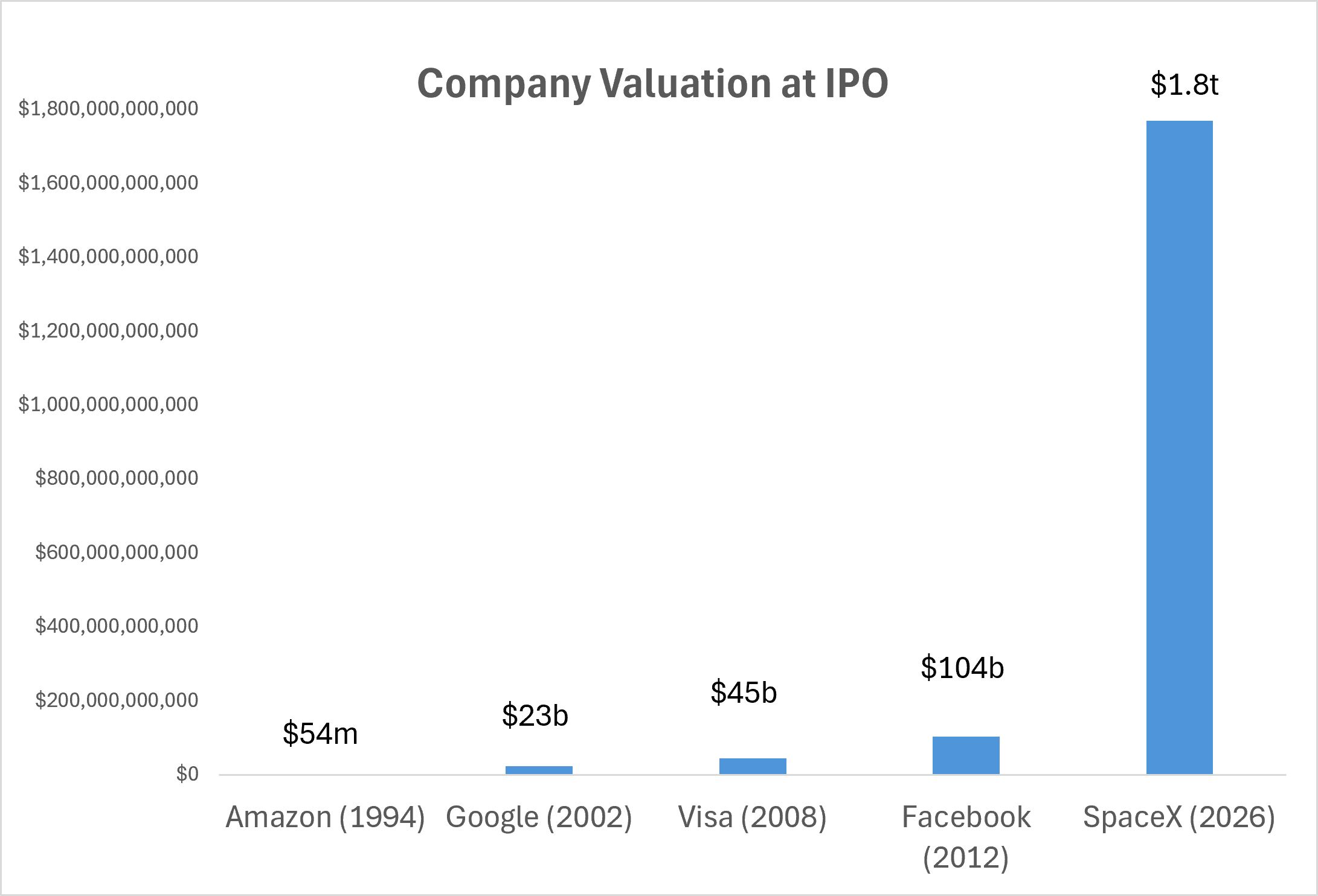
On the one hand, public investors may have less exposure to exponential growth of the kind experienced by early investors in Amazon in 1997. However, because these companies are in a more mature stage of their life cycle, there is more certainty about their ongoing viability.
The range of outcomes for these companies is narrower, as there’s less likelihood that Anthropic or SpaceX will go belly up, but less opportunity to get in on the ground floor. Through 2026, SpaceX has grown at a rate of roughly 60% per year from a valuation of $27 million in 2002. Most of the value created accrued to the founders and early-stage private investors.
High, Low, and In Between
Attention tends to bend towards the booms and the busts when it comes to IPOs. But the average experience is fairly pedestrian. We remember stocks like Amazon that we wish we had taken a flyer on early. We chuckle at (or regret) the hubris that went along with dumping money into Pets.com when it was losing an average of $57 on every sale it made.
Jay Ritter, director of The IPO Initiative at the University of Florida, has done substantial work looking at the history of IPOs. Earlier this year Ritter looked at returns for 1,645 IPOs that debuted between 2012 and 2024. He found the average 3-year buy-and-hold return, if shares were bought the day of the IPO, was 7.6%. The average return for the Morningstar US Total Market Index was 33.1%, more than four times the return of the average IPO.
This doesn’t mean that some of these companies won’t be great investments long-term. But it is fair to conclude that, given the much wider dispersion of potential outcomes for IPOs compared to a diversified market index, they hardly provide an attractive risk/reward tradeoff for investors. The highs are spectacular and the lows are dismal, but the average IPO investment is pretty unremarkable.
Opportunity Is Not a Plan
What if I miss the next great success story? Are these AI giants worth their current eye-popping valuations? Will today’s market caps look quaint 10 years down the road?
Amazon’s valuation in the early days wasn’t justified by its current results, but we know with hindsight that they grew far beyond investors’ dreams. Today’s IPOs are more established companies, which gives them the leg up on the startups from years past.
But even some of the successful giants of yesteryear later faded. In the early internet era, America Online (AOL) was synonymous with home internet access, Yahoo was the early dominant player in search, and Cisco was the leader in networking equipment and internet infrastructure. These firms grew rapidly, matured, and became profitable companies generating billions in annual earnings. They were much different than punching bags like Pets.com and eToys. And yet…
AOL merged with Time Warner in an ill-fated deal destined to be studied in business schools for decades to come. Investors in both companies came out worse for the wear.
Yahoo grew to $1 billion in annual earnings by 2005; as the decade turned, it made a run at competing with Google and Facebook but could not keep up. It stumbled along until finally being acquired by Verizon for $4.4 billion in 2017.
While the two above are cautionary tales in which early positions of strength were squandered or competed away, Cisco is a different story. The company hit a peak in March 2000 when it was briefly the most valuable company in the world at just over $500 billion. The tech bubble burst, but Cisco was not AOL, Yahoo, or Pets.com. It became a profitable, durable business that nevertheless did not reward investors at all for more than two decades. Cisco’s stock hit a peak of $80.06 per share on March 27, 2000, and it would not touch that level again until December 2025, a period of more than 25 years in the wilderness. Cisco shares grew 0% during a period when the S&P 500 returned 708%, according to Morningstar.
What Does This Say about Markets?
The arrival of a major IPO wave naturally raises a question: does a surge in new offerings signal a healthy market, or an overheated one? History offers examples supporting both views. Periods of enthusiastic IPO activity have often occurred late in market cycles, as strong stock prices, ample capital, and optimistic investors create favorable conditions for companies to go public.
During the late 1990s, a flood of technology IPOs preceded one of the largest market declines in modern history. In May, Denise Chisholm of Fidelity noted that “you can look back in history and say IPO booms are at least correlated with some potential busts in the sense that they usually correlate to euphoria in the stock market, which is usually around boom conditions in the economy, boom condition in earnings.” But as she notes, “we’re not there yet.” Given persistent inflation, rising interest rates, and overall lackluster economic growth, the U.S. economy is by no means experiencing a boom. Similarly, while the stock market is up for the year, returns have been modest overall, and far from euphoric.
In other words, while history suggests IPO activity can be a feature of euphoric markets, the broader backdrop matters. The existence of a busy IPO calendar alone does not necessarily mean investors are witnessing a replay of prior market peaks.
A separate but related question is what happens to the market itself when trillion-dollar-scale businesses join the public universe. Today’s offerings are arriving at valuations that rival many of the largest companies already in the S&P 500 and Nasdaq.
Index providers have mechanisms designed to reduce disruption. Most indexes use free-float adjustments, meaning only the shares available for public trading count toward a company’s index weight. Thus, while SpaceX was valued at $1.8 trillion, its inclusion in indexes is calibrated to the $75 billion worth of shares that were floated to the public. As a result, a newly public company may enter an index at a much smaller weight than its headline market capitalization would suggest. This process helps smooth the transition and prevents a small public float from immediately dominating indexes and disrupting markets.
Conclusion
The history of investing is filled with compelling stories. Some become transformative businesses, while others fade. Some become wonderful companies but disappointing investments. Investors do not need to correctly identify every future winner to achieve financial success.
It is interesting and intellectually stimulating to try to figure out who will be the next big thing, but for long-term investors, it should be a passing curiosity.
A successful retirement with financial independence based on flexibility and security comes from doing the regular, boring, repetitive work of saving, investing, diversifying, planning, and monitoring.
In our nearly 50 years of financial planning, we’ve yet to retire someone thanks to an IPO. But we’ve helped hundreds prepare for retirement through the nuts and bolts of good financial planning.
This article is intended for educational purposes only and should not be construed as investment advice, a solicitation, or a recommendation to buy or sell any security or investment product. Risks with investing in initial public offerings (IPOs) include extreme price volatility, limited operating history and potential ownership dilution. They may not be appropriate for every investor. You should read the prospectus carefully, and make your own determination of whether an investment in the offering is consistent with your investment objectives, financial situation, and risk tolerance. Past performance does not guarantee future results.
Presented by Christopher Rivers, CFP®, CRPC®